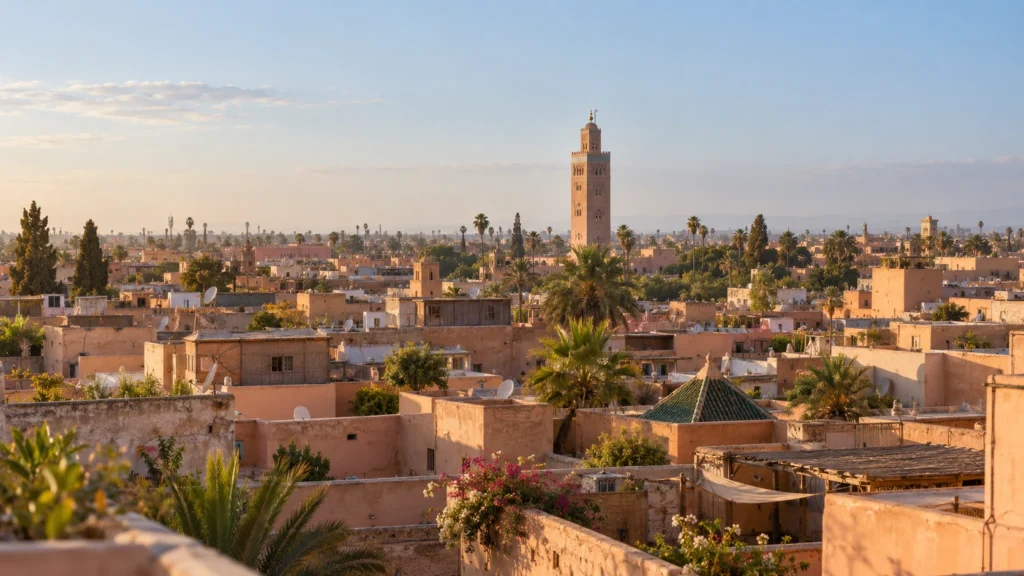
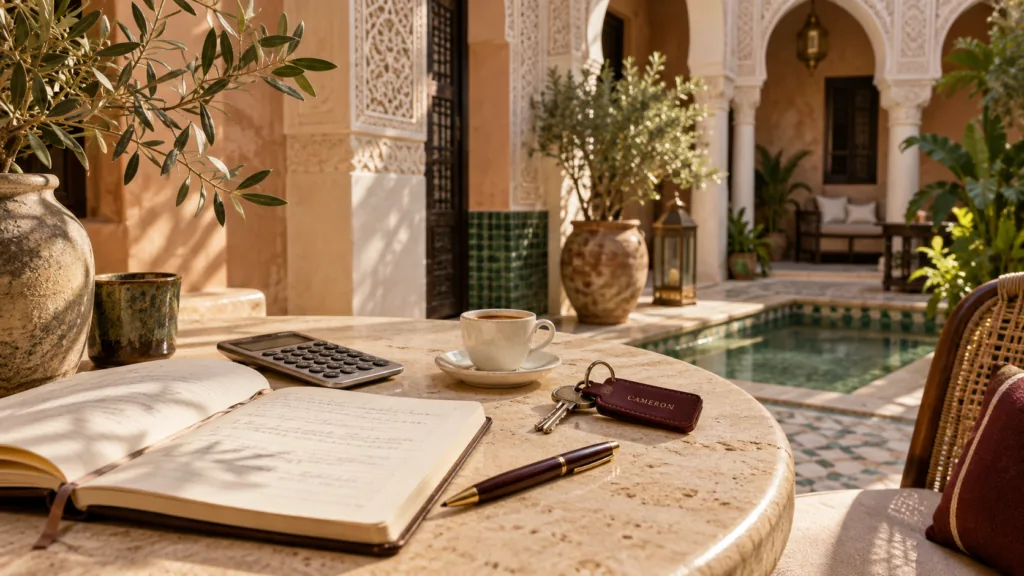
Between architectural heritage, particular land-tenure features and tourism regulations, buying a riad in Marrakech should not be approached lightly. Melkia, requisition, land title, guesthouse or Airbnb rental: here is what you genuinely need to know before buying.
By Cameron Immobilier Marrakech — November 2026
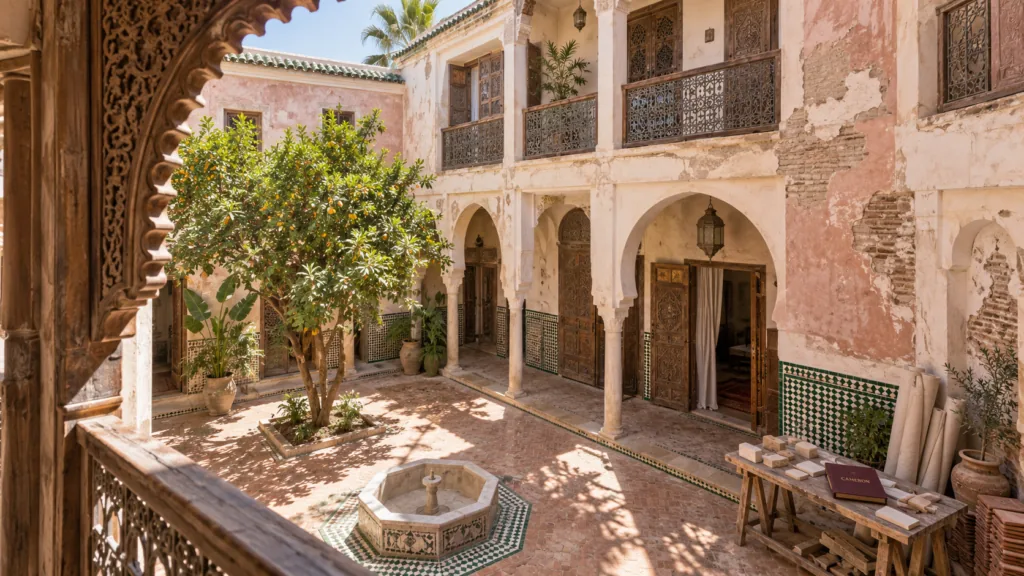
Sometimes, all it takes is stepping through an unassuming door in a Medina alleyway to discover an unexpected world: a light-filled patio, a fountain, zellige tiles, carved galleries and, upstairs, a terrace overlooking the rooftops of Marrakech.
That is the full charm of a riad. And it is often what creates an immediate emotional connection.
Yet behind this exceptional architecture lie legal, technical and administrative realities that must be understood before signing.
In Marrakech, not all riads have the same land-tenure status. Some are titled, others are held under a traditional melkia, while others are subject to a registration procedure.
Added to this is a second question, particularly important for investors: does buying a riad automatically give the right to operate it as a guesthouse or list it on Airbnb?
The answer is no.
To successfully complete a riad purchase in Marrakech, three fundamental aspects must be distinguished: ownership of the property, its real-estate compliance and the legal possibilities for operating it.
1. Melkia, requisition or land title: understanding the riad’s status
This is the first question to ask before any real-estate acquisition in the Medina.
In Morocco, a riad may be held under different land-tenure systems. These situations do not offer the same immediate safeguards or involve the same acquisition formalities.
| Land-tenure status | What it means | Main point to check |
|---|---|---|
| Definitive land title | Property registered with the Land Registry | Check registered rights, encumbrances and the property’s compliance |
| Melkia | Ownership established by traditional documents, without definitive registration | Check the origin of rights, inheritance matters and boundaries |
| Registration requisition | Procedure initiated to obtain a land title | Check progress, objections and any potential risks |
The land title: an important legal safeguard
The land title is issued by the National Agency for Land Registration, Cadastre and Cartography (ANCFCC).
It legally identifies the real-estate property, its owner and the rights registered against the building.
For the buyer, it generally represents the simplest situation to assess.
The notary must nevertheless check recent registrations, including mortgages, seizures, easements or any other possible encumbrances.
It is also necessary to ensure that the property viewed genuinely corresponds to that shown in the land documents.
This precaution is particularly helpful in the Medina, where some riads result from the amalgamation of several old houses.
A definitive land title provides fundamental security, but does not in itself guarantee that the works are compliant or confer the right to carry out a tourism activity.
Melkia: a fully valid traditional form of ownership
A melkia, also known as moulkia, is a traditional method of evidencing real-estate ownership, generally established through adoul documents and evidence demonstrating the origin of rights.
This system remains present in Marrakech’s historic districts.
Contrary to a fairly widespread belief, a riad held under melkia can legally be bought and sold..
The difference lies in the checks required to secure the transaction.
In particular, it is necessary to reconstruct the ownership history, review the successive deeds and confirm that the seller genuinely holds all the rights they intend to transfer.
Inheritance matters are a sensitive issue.
A house may have been passed down over several generations, with different heirs or co-owners. If certain rights have been overlooked or poorly documented, disputes may arise.
The property boundaries also require particular attention.
Traditional descriptions may refer to neighbouring owners, party walls or historic markers, without always offering the accuracy of a modern cadastral plan.
It may therefore sometimes be necessary to appoint a qualified professional to confirm the areas and boundaries.
Melkia is not a flaw in itself. However, it requires an in-depth legal review before committing.
Requisition: a title-registration process, not yet a land title
A registration requisition means that an official application has been filed with the Land Registry to obtain a land title.
It is an important step, but a requisition must never be confused with a definitive title.
The procedure includes, in particular, review of the application, official publications, boundary demarcation and the possibility for third parties to file an objection.
The ANCFCC provides, in particular, for a two-month period to lodge an objection following publication in the Official Bulletin of the notice of completion of boundary demarcation.
A requisition may therefore be at different stages.
One file may be close to completion, while another may be subject to an ownership dispute, a boundary-demarcation issue or legal proceedings.
For the buyer, the key point is to obtain the requisition number and have its exact status checked.
A simple assertion that “the title is in progress” is not sufficient.
2. How long does it take to obtain a land title?
This is a frequent question among buyers of riads held under melkia.
There is no guaranteed timeframe applicable to all properties.
Registration requires several formalities: review of documents, publications, boundary-demarcation operations, objection periods and a decision by the Land Registry.
In a case without particular difficulties, the procedure may progress normally.
However, an inheritance dispute, disagreement over boundaries or an objection may substantially extend the timeframe, sometimes for several years.
It would therefore be imprudent to systematically promise a land title within a few months.
Before buying, the priority is to understand the actual stage of the procedure.
Has boundary demarcation been completed? Have the publications been finalised? Are there any objections? Has the Land Registry requested additional documents?
These points will enable the notary to assess the risks.
Where a buyer absolutely wishes to obtain a definitive title, this condition must be considered in the legal structure of the transaction.
3. How does buying a riad in Marrakech work?
A well-prepared transaction follows several stages.
First stage: review the legal file
Before paying a deposit, it is important to obtain the documents corresponding to the property’s land-tenure situation.
For a titled riad, the notary will review, in particular, the up-to-date ownership certificate and any registered entries.
For a melkia, the review will focus more on the origin of rights, previous deeds, inheritance matters and the property boundaries.
For a requisition, the documents relating to registration must also be reviewed.
The seller’s identity and capacity to sell are essential.
Where a company owns the riad, its legal documents and the signatory’s authority must also be checked.
Second stage: inspect the reality of the building
A beautiful renovation does not guarantee the absence of defects.
Older riads may have issues with damp, waterproofing, floors, pipes or structure.
Particular attention should be paid to buildings that have been extended upwards or created by combining several houses.
An expert assessment by an architect, engineer or other qualified professional can prove invaluable.
Areas must also be verified.
In the Medina, ground area, built area, living area and terraces are sometimes presented differently from one listing to another.
It is important to know precisely what is included in the price.
Third stage: formalise commitments
Moroccan law has recently evolved.
Since the reform introduced by Law No. 41-25, published in the Official Bulletin of 16 July 2026, real-estate deeds within its scope are subject to a strengthened requirement for an authentic instrument.
This reform applies in particular to transfers of real-estate ownership, agreements to sell and certain powers of attorney.
Drawing up a simple private document therefore cannot replace the required legal formalities.
Using a notary or another professional legally authorised for the relevant deed makes it possible to formalise the necessary commitments and guarantees.
Depending on the file, it may be useful to provide for conditions precedent or prior conditions relating to financing, certain land formalities or essential documents.
Fourth stage: signing and formalities
Once the checks have been completed and the agreed conditions met, the final deed can be signed.
Payments must be arranged securely and with traceability.
Tax and land formalities then follow according to the property’s status.
For a titled building, the transfer must in particular be registered on the land title.
For an unregistered property, the formalities will be adapted to its situation.
4. Buying a renovated riad from a property trader: precautions to take
The Marrakech market includes many riads bought, restored and then resold by professionals.
These projects contribute to the restoration of part of the Medina’s real-estate heritage.
For a buyer, a renovated riad may offer a genuine advantage: the works have been completed, the facilities are modern and the property may sometimes be occupied quickly.
However, the appearance of the building must be distinguished from its legal file.
Consider a common situation: a professional purchases a house held under melkia, initiates a registration procedure, carries out a complete renovation and then resells the property.
The buyer must then check three essential elements.
Ownership: does the seller genuinely hold all rights in the riad?
Works: do the alterations carried out comply with the applicable rules?
Operation: can the riad legally be used as the future owner intends?
This last question is particularly important when a property is presented as a tourism investment.
A riad with four or five bedrooms, even if fully renovated and equipped, does not automatically have guesthouse authorisation.
Commercial potential and administrative compliance must be assessed separately.
5. What are the costs of buying a riad in Morocco?
The price negotiated with the seller is not the total cost of the transaction.
Several costs must be added to the initial budget.
For the standard acquisition of a built property, registration duties are generally 4%, subject to the tax provisions applicable to the transaction.
For a standard transfer involving a registered property, Land Registry fees are generally calculated at 1.5%, plus certain fixed fees.
Notary’s fees, disbursements and any agency fees must also be allowed for.
A transaction involving melkia or an initial registration may give rise to additional steps and costs.
Payment requirements since July 2026
Since 1 July 2026, certain real-estate transfers priced above 300,000 dirhams may be subject to an additional 2% registration duty where the legal requirements concerning payment disclosure and traceability are not met.
This measure makes the use of compliant payment methods and retention of supporting documents particularly important.
To prepare your budget, Cameron Immobilier provides a notary and acquisition cost calculator for Morocco.
It is always advisable to request a personalised breakdown before signing.
6. Can a riad be converted into a guesthouse?
This is an essential question for investors.
A riad may be entirely legal as a private residence without being automatically authorised to accommodate tourist guests.
It is therefore necessary to distinguish ownership rights, the building’s permitted use and the regime applicable to the intended activity.
A riad used as a private residence
An owner may acquire a riad to live in, use as a second home or enjoy with their family.
This residential use does not necessarily involve authorisation for tourism operations.
However, converting this residence into a commercial accommodation establishment may require further formalities.
A guesthouse: a regulated tourism establishment
Moroccan Law No. 80-14 governs tourism establishments and other forms of accommodation.
It recognises, in particular, guesthouses, Riads, hotels, tourist residences and several other categories.
The classification standards published in 2025 modernised the system.
Guesthouses are now classified from 1 to 5 stars.
Tourism establishments in the “Riad” category, for their part, have classifications of 3 stars, 4 stars, 5 stars and Luxury.
This distinction is important.
A traditional house described as a riad in a real-estate listing is not necessarily a tourism establishment classified as a Riad.
Classification depends on specific regulatory criteria.
Can a four-bedroom riad become a guesthouse?
The answer depends on the intended tourism category and the characteristics of the building.
The number of bedrooms is one factor for assessment, but it is not the only one.
Areas, sanitary facilities, communal spaces, safety conditions, access and the services offered must also be assessed.
The applicable standards differ according to the type of establishment and its classification.
A four-bedroom riad should therefore not be considered automatically authorised for tourism operations or definitively excluded from them.
Before buying with a commercial objective, the building must be assessed against the official standards for the sought category.
Tourism services and the Regional Investment Centre can help guide the project holder towards the corresponding procedure.
An administrative feasibility study carried out before purchase can prevent a significant investment mistake.
7. Can you rent out your riad on Airbnb or Booking?
The popularity of Airbnb and Booking.com in Marrakech may create the impression that tourist rentals are unrestricted once you own a real-estate property.
In reality, publishing a listing on a platform does not constitute administrative authorisation to operate.
The situation depends on the actual nature of the activity.
Renting several bedrooms to travellers
Where a riad markets different bedrooms, accommodates tourists in succession and provides accommodation services, the regime applicable to tourism establishments must be examined.
If the activity falls within a regulated category, the corresponding authorisations must be obtained.
Renting the entire riad for a few nights
The rental of an entire property for a few days presents a different situation.
It is not necessarily treated in every case as a guesthouse operated room by room.
However, this does not mean that a private residence can automatically be marketed for nightly rental without formalities.
The legal framework applicable to the project’s actual operation must be determined.
In particular, the owner must clarify whether the rental is occasional or permanent, whether services are provided and who legally operates the business.
Written confirmation from the competent authorities is preferable to a simple statement by an intermediary.
Can a concierge service make the operation legal?
A concierge service may manage bookings, welcome guests, cleaning and various arrangements entrusted to it under contract.
However, its involvement alone cannot turn a private residence into an authorised tourism establishment.
Its commercial status does not replace any authorisations that may be required for the building and the activity.
The home-hosting regime is also a specific category, linked in particular to the residence where the individual has established their domicile. It does not automatically correspond to the permanent operation of an investment riad.
To understand the different situations, see our guide to seasonal rentals in Marrakech and the legal requirements according to accommodation type.
8. How do you obtain authorisation to operate a tourism business?
Law No. 80-14 and its implementing texts set out the procedures for authorisation and classification of tourism establishments.
For the relevant categories, the application for provisional classification and operating authorisation is submitted, in particular, through the Regional Investment Centre (CRI), in accordance with the regulatory procedure.
The project must be assessed according to its category.
Standards may relate to areas, facilities, sanitary installations, safety conditions and service quality.
The building’s planning compliance and any authorisations linked to works that may have been carried out must also be checked.
After opening, the establishment must comply with the relevant operational classification formalities and inspections.
Recent regulatory developments have, in particular, introduced an enhanced service-quality assessment system, including mystery visits for several categories of classified establishments.
Since 2026, the system has applied in particular to guesthouses and Riads classified as 3 stars or above.
Can you open before obtaining your authorisation?
For an activity subject to prior authorisation, submitting an application does not constitute operating authorisation.
Law No. 80-14 provides for penalties in the event of opening or operating without the required authorisation, where the situation falls within its scope.
The fines provided for under Article 43 range from 50,000 to 500,000 dirhams.
It is therefore essential not to base a financial project on tourism operations that have not yet received administrative approval.
Official procedures and documents are available from the Moroccan Ministry of Tourism.
9. Buying a riad already operating as a guesthouse: what should be checked?
A riad presented as an operating guesthouse may appear simpler to acquire.
The bedrooms are fitted out, the establishment already receives guests and a commercial activity exists.
However, it is necessary to determine precisely what is included in the sale.
Does it concern only the building? Is the business goodwill included? Are the equipment, furniture and contracts part of the transaction?
Is the company operating the establishment also included?
These factors can have a significant impact on the property’s value.
Tourism authorisation must be checked
Existing administrative decisions should be requested and verified to ensure that they correspond to the category and activity actually carried out.
In the event of a change of owner or operator, the formalities required to continue the activity must be considered.
An authorisation issued in a particular context should not be presumed automatically transferable in every sale structure.
Profitability must be demonstrated
A tourism establishment has two economic components: the value of its real estate and that of its operation.
The buyer must therefore examine actual turnover, costs, seasonality, occupancy rates and any expenditure to be expected.
Platform commissions, staff, energy costs, laundry, maintenance and taxation must be included.
A guesthouse may display excellent guest reviews without generating sufficient profitability.
To assess a project, our rental yield calculator for Marrakech enables an initial projection, to be supplemented by a study tailored to tourism operations.
10. Renovating a riad in the Medina: heritage, works and access
The Medina of Marrakech has been a UNESCO World Heritage Site since 1985.
This recognition highlights the exceptional value of its urban fabric and traditional architecture.
It does not mean that every residence is individually listed as a historic monument, but works may be subject to specific construction, planning and heritage-protection rules.
Raising a building, altering a structure, modifying a terrace or combining several houses may require authorisations.
The applicable rules depend on the nature of the works and the property’s location.
The terrace: an asset to verify
Terraces are often one of the riad’s principal selling points.
However, the presence of a plunge pool, pergola or additional structure does not guarantee that these features are authorised.
Technical considerations are equally important.
Waterproofing, drainage and the floors’ capacity to bear loads must be assessed, particularly where a swimming pool or plunge pool has been installed.
Access: an essential criterion in the Medina
The location of a riad is not simply a matter of its distance from Jemaa el-Fna square.
Some properties benefit from relatively easy access from a car park or vehicle-accessible road.
Others require several minutes’ walk through narrow alleyways.
This feature may be appealing for a private residence, but it must be anticipated where a tourism activity is envisaged.
Guest arrivals with luggage, deliveries, maintenance and works may all be considerably affected.
Before buying, it is therefore important to assess not only the riad but also its immediate surroundings.
To better understand the specific characteristics of these areas, discover our guide to real estate in the Medina of Marrakech.
11. Can a foreign national buy a riad in Marrakech?
Yes, the acquisition of urban real estate by a foreign national is generally possible in Morocco, subject to the property’s legal nature and any applicable specific rules.
Buying a riad in the Medina must in particular be distinguished from transactions involving certain land intended for agricultural use.
For foreign investors, the origin and traceability of funds are important considerations.
The Office des Changes provides, subject to conditions, for a convertibility regime applicable to foreign investments made in accordance with regulations.
This regime may allow the transfer of resale proceeds and certain income linked to the investment.
It is therefore essential to retain bank documents relating to the financing and acquisition.
The choice between purchasing in one’s own name or through a company should also be assessed according to the project, the buyer’s tax residence and any commercial activity.
12. Essential checks before signing
Before buying a riad in Marrakech, several questions should have received a clear answer.
Land-tenure status: does the property have a definitive title, a melkia or a requisition? Are the seller’s rights properly established?
Boundaries and areas: do they correspond to the documents and the reality of the building?
Encumbrances and disputes: are there mortgages, objections, inheritance disputes or third-party rights?
Works: are the structural alterations and improvements carried out compliant?
Technical condition: have the structure, floors, networks and terraces been inspected?
Property use: private residence or establishment already authorised to carry out a tourism activity?
Intended operation: are the riad’s characteristics compatible with the required category and authorisations?
Total budget: have acquisition costs, works, equipment and charges been properly assessed?
Timeframes: have the remaining stages been identified, particularly where there is a requisition or a tourism-conversion project?
A difficulty does not necessarily prevent a transaction. However, it must be known, assessed and addressed before making a final commitment.
Frequently asked questions about buying a riad in Marrakech
Is it risky to buy a riad held under melkia?
A melkia is not necessarily synonymous with high risk. Everything depends on the quality of the ownership file, previous deeds and the absence of disputes. However, it requires more thorough checks than a property that is already registered.
Can you buy a riad subject to a requisition?
Yes, acquisition may be considered under certain conditions. However, the exact status of the procedure, any objections and the available safeguards must be checked. A requisition is not a definitive land title.
How long does buying a riad in Marrakech take?
A titled, complete and uncomplicated file may be handled within a few weeks or a few months. A complex melkia, unsettled inheritance matter or disputed requisition may require considerably more time.
Can a titled riad be listed directly on Airbnb?
No, not automatically. The land title establishes real-estate rights. It does not constitute authorisation for tourism operations. The applicable regime must be determined according to the nature of the rental.
Can you open a guesthouse with four bedrooms?
The answer depends on the type of establishment, capacity standards and the intended classification. Four bedrooms alone are insufficient to establish whether the project is eligible or ineligible.
Can a private residence be converted into a guesthouse?
This may be possible where the building’s characteristics and administrative position allow the applicable rules to be met. A preliminary study is required before treating operation as feasible.
Does a guesthouse retain its authorisation when sold?
The formalities depend on the structure of the sale and the identity of the operator. The administrative conditions for continuing the activity must be checked before acquisition.
Is it preferable to buy a riad that already has a land title?
For a buyer wishing to limit land-tenure uncertainties, a definitive title generally represents an important advantage. This does not mean that a property held under melkia is necessarily a poor investment.
Buying a riad in Marrakech: a sound investment begins with the right checks
Buying a riad often means acquiring far more than a house.
It means entering Marrakech’s architectural history, preserving a distinctive living space and, sometimes, bringing a tourism or heritage project to life.
But a property’s charm must never obscure the realities of its acquisition.
A melkia is not a land title. A requisition is not a completed registration. A renovation does not guarantee the building’s compliance. And the ability to host travellers is not simply a matter of creating an Airbnb listing.
A successful purchase rests on three fundamentals: legally secure ownership, a building suited to the project and use that complies with the applicable rules.
At Cameron Immobilier Marrakech, we prioritise a search based on each buyer’s genuine requirements: a private residence, family home, heritage investment or tourist-accommodation project.
This approach makes it possible to select properties while taking into account their location, characteristics, potential and the checks to be undertaken with qualified professionals.
Are you considering buying a riad in the Medina?
Discover our selection of riads for sale in Marrakech or entrust your real-estate search to Cameron.
A beautiful riad inspires love at first sight. A well-prepared purchase lets you enjoy it with peace of mind.
Official texts and references
- ANCFCC — Land-registration procedure
- Moroccan Code of Real Rights — Law No. 39-08, to be read taking into account Reform No. 41-25 published in Official Bulletin No. 7526 of 16 July 2026.
- Ministry of Tourism — Law No. 80-14 and regulatory texts on tourist accommodation
- Ministry of Tourism — Provisional classification and operating authorisation
- Office des Changes — Making a foreign investment in Morocco
- UNESCO — Medina of Marrakech
Each property has its own characteristics. Land, technical and administrative checks must be tailored to the property and the intended project.